




-

"Very nice Posters. The quality is amazing and we received it very quickly !"
-

"A shop to visit absolutely. Huge selection of posters. We spent more than an hour there !"
-

"Perfect to find gift. Price are very good. An they can frame and pack it on site"


About the Artist
Otto Freundlich was a German modernist who played a significant role in early European abstraction. Working between Paris and Germany, he sought to create an art that transcended national boundaries, emphasizing unity and shared humanity. In the 1920s, Freundlich’s vision was shaped by the search for harmony after the devastation of World War I, and his work became emblematic of the avant-garde spirit of the interwar period.
Freundlich’s art bridged the gap between Cubist fragmentation and utopian abstraction. Tragically, his work was later condemned by the Nazi regime, symbolizing the suppression of modernist ideals. Today, his legacy endures as a testament to the power of abstraction to communicate universal values.
The Artwork
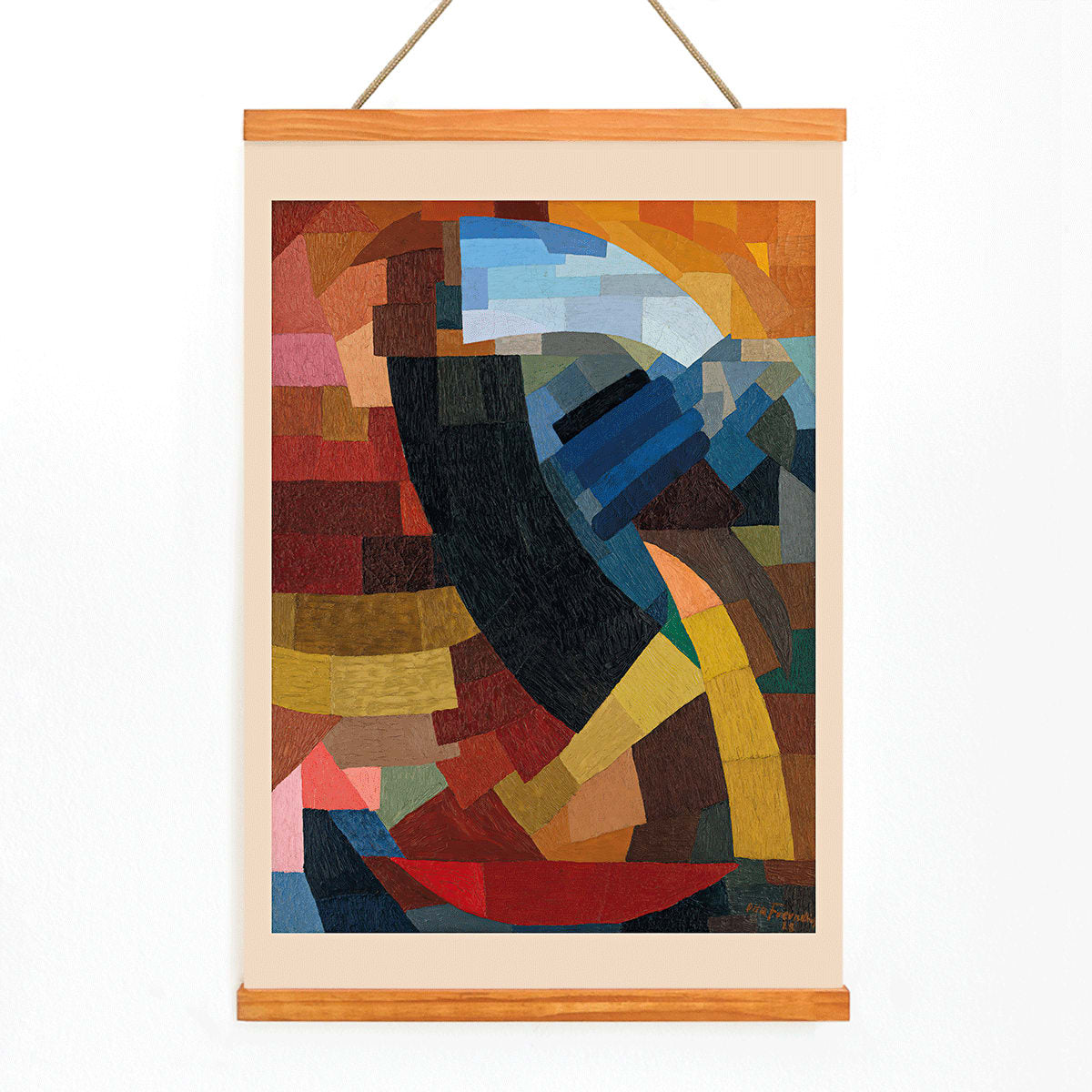
Fragments de figure, created in 1928, reflects the postwar quest for a universal visual language. Rather than depicting a traditional portrait, Freundlich deconstructs the human figure into geometric components, inviting viewers to sense presence through rhythm and structure. The title alludes to the underlying human theme, even as the composition moves boldly into abstraction.
This artwork embodies the belief that harmony in art could inspire harmony in society, a hope shared by many artists of the era. Its abstract approach mirrors the interwar optimism that creativity could foster understanding and peace.
Style & Characteristics
The composition is constructed from interlocking geometric shapes, each delineated by pronounced black contours. Vivid blocks of primary color—red, blue, and yellow—are set against deeper earth tones, producing striking contrasts and a dynamic visual rhythm.
The arrangement feels both architectural and animated, as if the fragments are assembling and dissolving simultaneously. The overall effect is energetic and optimistic, making this work a striking example of abstract wall art. It pairs naturally with other pieces in the abstract collection.
In Interior Design
This 1920s modernist poster serves as a compelling focal point in living rooms, hallways, or creative workspaces, especially when displayed on a light-colored wall to highlight the bold outlines. It complements mid-century and contemporary interiors, as well as spaces inspired by geometric modernism, such as those featuring Bauhaus influences.
Consider framing it in black or natural wood and pairing it with textiles that echo one or two of its colors. For a gallery wall, it harmonizes beautifully with works from famous artists without overwhelming the arrangement.