




-

"Very nice Posters. The quality is amazing and we received it very quickly !"
-

"A shop to visit absolutely. Huge selection of posters. We spent more than an hour there !"
-

"Perfect to find gift. Price are very good. An they can frame and pack it on site"


About the Artist
László Moholy-Nagy was a pivotal member of the Bauhaus movement, renowned for his innovative approach to art, design, and education. His work bridged painting, photography, and industrial design, emphasizing the importance of visual literacy in a rapidly modernizing world. Moholy-Nagy believed that art should reflect and respond to technological progress, encouraging viewers to engage more deeply with form and perception.
His contributions helped shape the Bauhaus ethos, blending rigorous experimentation with a drive to make art accessible and relevant to everyday life. Collectors interested in Bauhaus posters often appreciate his ability to harmonize structure and spontaneity within a single composition.
The Artwork
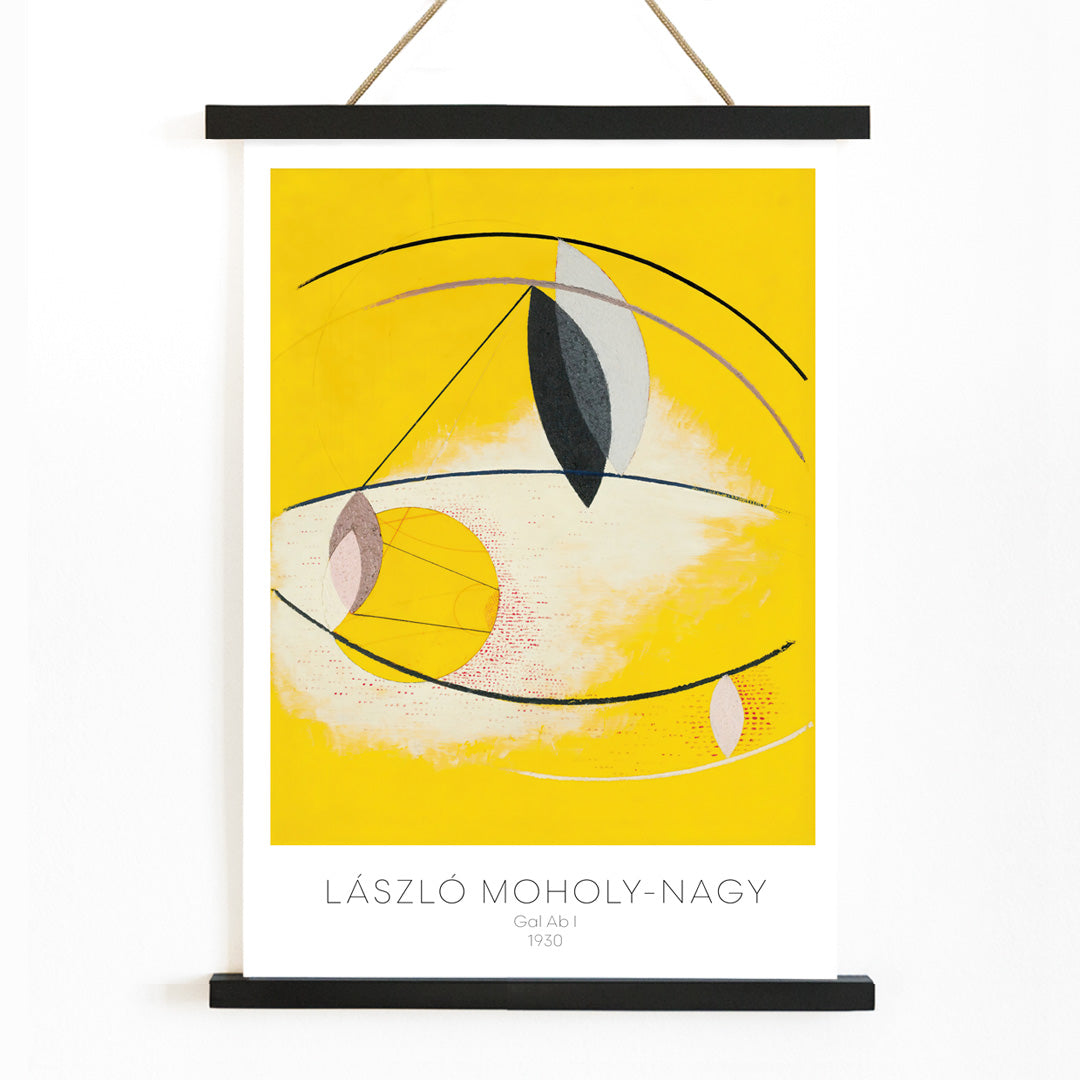
Gal Ab I emerged during a transformative era when artists reimagined the possibilities of the poster as both art and experiment. Rather than narrating a scene, this piece explores how simple geometric forms can generate visual energy and movement. The work reflects the optimism and forward-thinking spirit of 1930, a time marked by technological innovation and a fascination with abstraction as a universal language.
Created at the intersection of engineering, cinema, and graphic design, this composition embodies the Bauhaus ideal of uniting art and industry. Its abstract arrangement invites viewers to interpret meaning through balance, rhythm, and spatial tension, making it a hallmark of modernist visual culture. For those drawn to abstract wall art, it represents a moment when design and fine art converged in new and exciting ways.
Style & Characteristics
The artwork features a vivid yellow field set against a crisp white background, with bold black shapes and subtle grey accents providing contrast and depth. Geometric forms—circles, arcs, and diagonals—are arranged with meticulous precision, creating a sense of dynamic movement across the surface.
Clean, sharp edges and flat color application emphasize proportion and alignment over illusionistic detail. The overall mood is energetic and optimistic, capturing the essence of Bauhaus design. This piece resonates with those who appreciate graphic, architectural compositions and the clarity of modernist abstraction.
In Interior Design
This modernist art print makes a striking focal point in living rooms, offices, or entryways, where its structured energy can set the tone for the space. It complements minimalist, Scandinavian, and industrial interiors, especially when paired with black frames, chrome accents, or light woods.
To echo the artwork’s palette, incorporate yellow accents through cushions or accessories, and maintain a scheme of white, grey, and black for cohesion. It also integrates seamlessly into a gallery wall alongside black and white prints and other geometric classics, enhancing a curated, contemporary look.