




-

"Very nice Posters. The quality is amazing and we received it very quickly !"
-

"A shop to visit absolutely. Huge selection of posters. We spent more than an hour there !"
-

"Perfect to find gift. Price are very good. An they can frame and pack it on site"


About the Artist
Ohara Koson was a master of Japanese kacho-e, the bird-and-flower genre, and played a significant role in the early 20th-century shin-hanga movement. His refined approach brought a poetic sensibility to traditional subjects, blending careful observation with a sense of tranquility that appealed to both Japanese and international collectors.
For those interested in Japanese woodblock art, the Ohara Koson collection offers a window into his world of birds, foliage, and seasonal change, where each print is a meditation on nature’s fleeting moments.
The Artwork
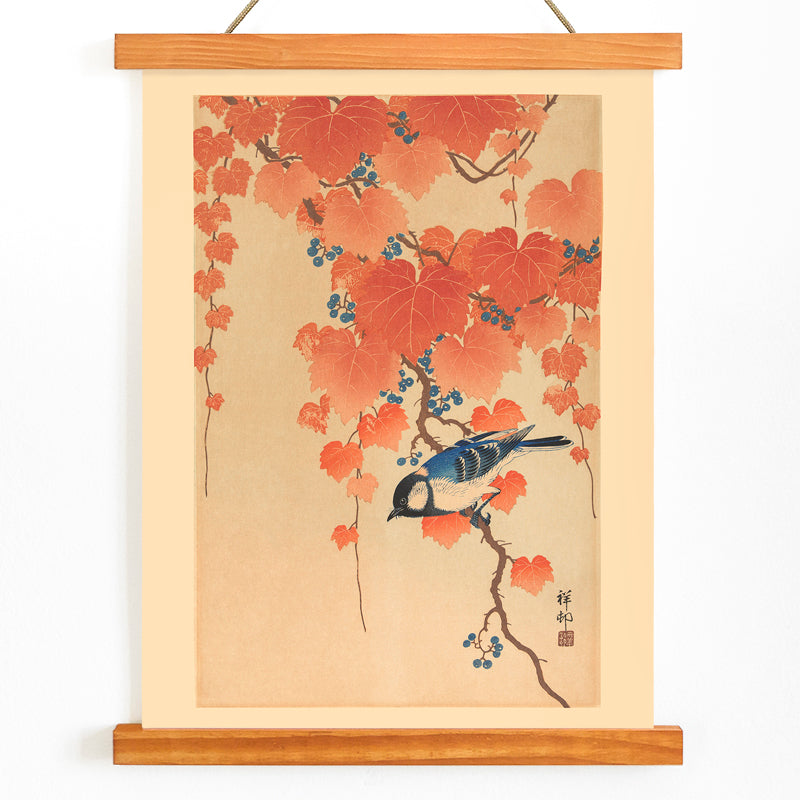
Created in 1910, this print reflects Koson's fascination with the subtle drama of seasonal transitions. The image of a small blue bird perched on a paulownia branch, surrounded by autumn leaves and berries, evokes the quiet pause between summer and fall. In Japanese art, such pairings serve as visual poetry, capturing the mood of a particular time of year and encouraging viewers to appreciate nature’s delicate rhythms.
This work emerged during a period when traditional woodblock techniques were being revived for modern audiences, making it both a nod to the past and a fresh decorative statement for early 20th-century homes.
Style & Characteristics
The composition is vertically oriented and elegantly spare, with the paulownia branch extending through open space to draw the eye upward. A soft beige background creates a sense of calm and openness, while the warm orange leaves and clusters of berries add gentle contrast.
The bird’s vivid blue plumage stands out against the muted tones, forming a harmonious palette of blue, orange, and neutral hues. The print’s clean lines and subtle gradations of color are hallmarks of Japanese woodblock printing, giving the piece a polished, contemplative quality.
In Interior Design
This Japanese art print brings a serene, contemplative touch to bedrooms, reading nooks, or hallways, especially in minimalist, Japandi, or classic interiors. Its vertical format is ideal for narrow wall spaces and pairs well with natural wood, linen, and simple ceramics.
Consider echoing the print’s beige and blue palette in your decor, or combine it with other bird prints and elegant Japanese wall art to create a harmonious gallery wall that celebrates nature’s quiet beauty.