




-

"Very nice Posters. The quality is amazing and we received it very quickly !"
-

"A shop to visit absolutely. Huge selection of posters. We spent more than an hour there !"
-

"Perfect to find gift. Price are very good. An they can frame and pack it on site"


About the Artist
James Reynolds was a distinguished British chartmaker of the mid-19th century, active during a period when astronomy was becoming increasingly accessible to the public. His work reflects the Victorian enthusiasm for science education, as illustrated charts and diagrams brought celestial knowledge into homes, schools, and lecture halls. Reynolds’s contributions are recognized for bridging the gap between scientific rigor and popular understanding, making complex subjects approachable for amateur astronomers and curious minds. This piece finds a natural place among the scientific illustration collection, resonating with those who appreciate vintage instruments of learning.
His charts exemplify the era’s drive to democratize knowledge, offering both practical guidance and a sense of wonder about the universe.
The Artwork
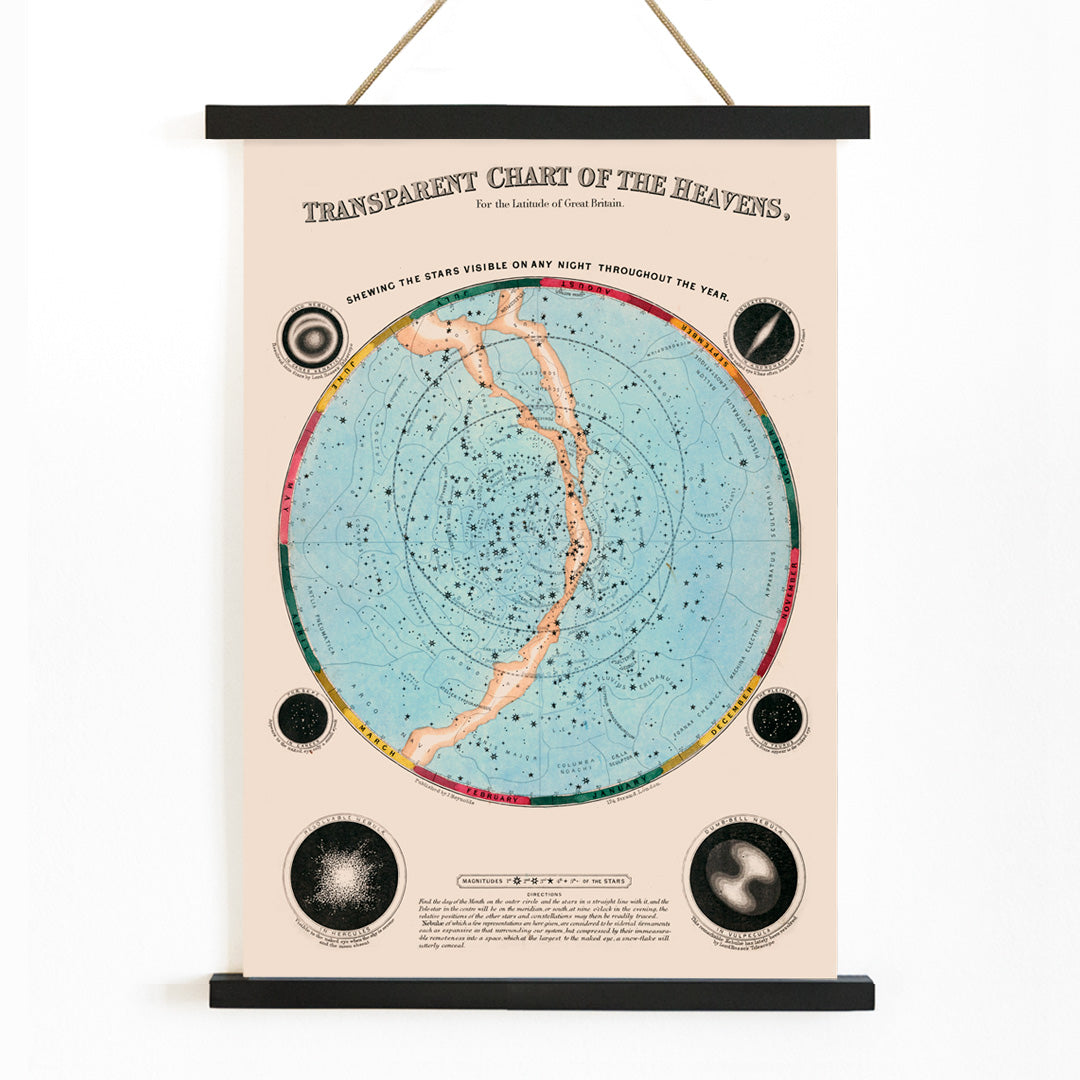
Transparent Chart of the Heavens, published in 1850, was designed as a functional tool for stargazers, enabling users to align the chart with specific dates and times to reveal which constellations would be visible overhead. This planisphere-style print reflects the Victorian passion for self-improvement and the popularization of astronomy, serving as both an educational aid and a daily companion for those fascinated by the night sky. It embodies the period’s belief in understanding nature through systematic observation and order.
By integrating astronomical data with visual clarity, the chart encouraged a hands-on approach to learning, making the cosmos tangible for everyday viewers.
Style & Characteristics
The artwork features a large circular map at its center, surrounded by concentric rings marked with months, dates, and times. Fine black linework delineates the constellations, star points, and celestial paths, while clear labels and diagrammatic figures enhance usability. Subtle washes of blue highlight certain regions, with gentle hints of green and pink adding depth to the otherwise restrained palette. The background is a warm beige, lending the print a sense of age and authenticity. The overall effect is orderly and contemplative, balancing scientific precision with visual harmony—an exemplary piece for a space-themed gallery wall.
In Interior Design
This celestial map poster is well-suited for spaces that invite curiosity and reflection, such as studies, libraries, or bedrooms. Its neutral tones and detailed composition complement both classic and contemporary interiors, pairing beautifully with natural woods, brass accents, and soft textiles. Collectors of cartographic art will find it harmonizes with works from the maps collection, while its understated colors can be echoed in navy or charcoal decor elements. The result is a timeless focal point that rewards close inspection and sparks conversation.