




-

"Very nice Posters. The quality is amazing and we received it very quickly !"
-

"A shop to visit absolutely. Huge selection of posters. We spent more than an hour there !"
-

"Perfect to find gift. Price are very good. An they can frame and pack it on site"


About the Artist
Michel Eugène Chevreul was a pioneering French chemist whose 19th-century research fundamentally changed the way color was understood and applied. His exploration of how adjacent colors influence perception laid the groundwork for modern color theory, impacting artists, designers, and manufacturers alike. Chevreul’s scientific approach bridged the gap between laboratory research and the visual arts, making his work a lasting reference for those interested in the science of color.
This piece is a natural fit within our science posters and prints collection, celebrating the intersection of knowledge and visual culture.
The Artwork
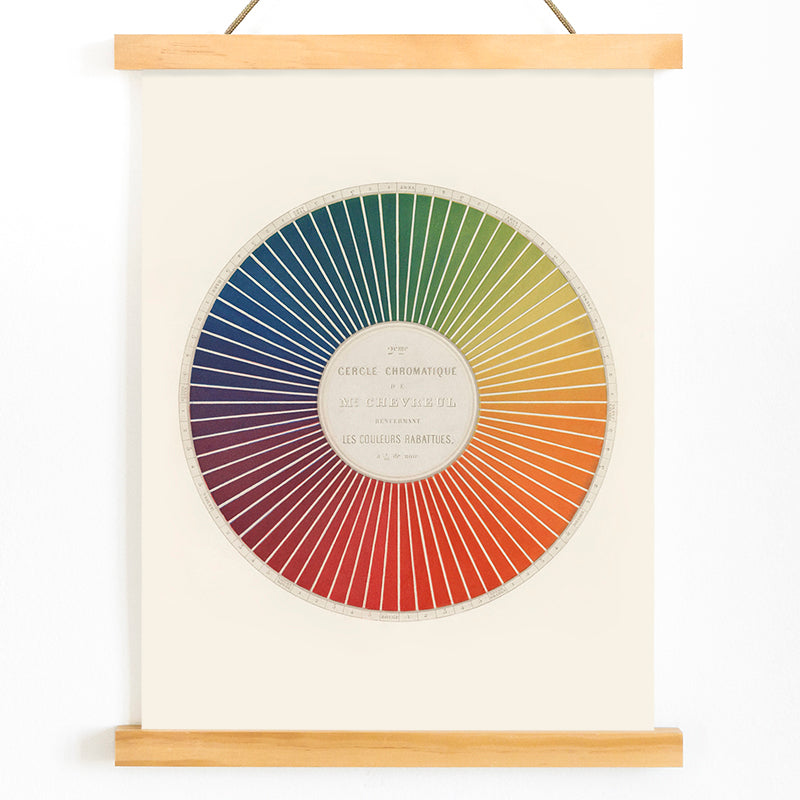
Created in 1861, Cercle chromatique emerged during a period when color classification was becoming essential for practical fields such as textile production, painting, and printmaking. Rather than serving as decorative art, this chart was conceived as a precise tool to standardize the understanding and communication of color relationships. In its historical context, it enabled clearer dialogue about hues and mixtures in workshops and classrooms, supporting the growing professionalism of visual trades.
Chevreul’s theories would later inspire avant-garde artists exploring optical effects and color harmonies, ensuring the continued relevance of this vintage print as both a scientific document and a cultural artifact.
Style & Characteristics
The artwork features a meticulously organized circular diagram, with concentric rings and radiating segments labeled in clear typography. The spectrum transitions smoothly through reds, oranges, yellows, greens, and blues, each section precisely delineated. The design is clean, geometric, and instructional, embodying the spirit of early information graphics while maintaining a subtle decorative appeal.
Its abstract structure makes it a compelling companion to abstract art prints and other design-forward pieces, lending visual order to any curated wall.
In Interior Design
This scientific print is ideal for creative workspaces, studios, or home offices where clarity and inspiration are valued. The circular form introduces movement and structure to gallery walls, while the full spectrum of color enlivens minimalist or contemporary interiors. It also complements design-led spaces with a Bauhaus sensibility or a focus on disciplined form.
Pair with neutral backgrounds and natural materials, and consider matching accent colors in textiles for a cohesive look. For a tailored finish, browse our frames collection to suit your space.