




-

"Very nice Posters. The quality is amazing and we received it very quickly !"
-

"A shop to visit absolutely. Huge selection of posters. We spent more than an hour there !"
-

"Perfect to find gift. Price are very good. An they can frame and pack it on site"


About the Artist
Julius Wiesner was an Austrian botanist whose pioneering work in plant physiology intersected with the visual documentation of scientific discoveries. Active in the late 19th and early 20th centuries, Wiesner contributed to a period when microscopy and photographic techniques transformed how scientists observed and communicated the natural world. His efforts helped establish the importance of accurate visual records in botanical and biological research.
The Artwork
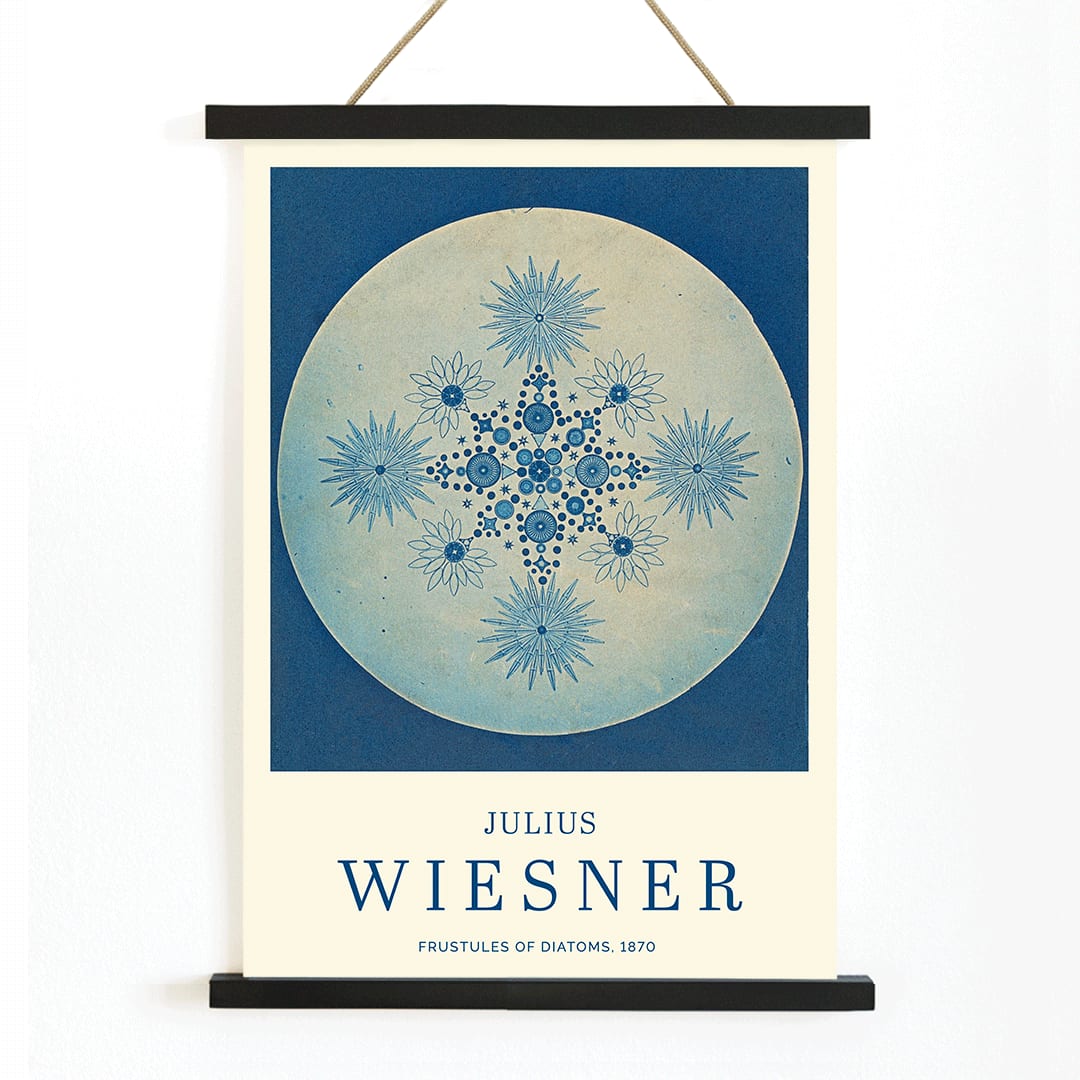
This 1910 illustration, Frustules of diatoms, was created during a time when microscopic algae were central to scientific study. Diatoms, with their intricate silica shells, fascinated researchers for their ecological significance and their use in water quality assessment. Such reference plates were produced to aid teaching and identification, reflecting a broader movement to make microscopic wonders accessible beyond the laboratory. The artwork embodies the era’s drive to merge scientific accuracy with visual clarity, serving both as an educational tool and a testament to the beauty found in scientific observation.
Style & Characteristics
The print features a striking cyanotype aesthetic, with a rich blueprint blue background highlighting the delicate, white forms of diatom frustules. Each specimen is rendered with crisp detail, arranged in an orderly, almost architectural composition that emphasizes symmetry and variation. The negative space and fine lines create a sense of calm and precision, lending the piece a minimalist, modern feel. This cool-toned palette harmonizes well with blue-toned art prints and complements the analytical spirit of science wall art.
In Interior Design
This fine art print is ideal for spaces that value clarity and tranquility, such as home offices, reading corners, or contemporary bathrooms. Its blueprint tones pair beautifully with white walls, pale wood, and sleek metallic accents, fitting seamlessly into Scandinavian and modern interiors. For a cohesive look, consider displaying it alongside other structured works from minimalist wall art, using a white mat to enhance its airy contrast. It is a refined choice for those who appreciate the intersection of science and design.