




-

"Very nice Posters. The quality is amazing and we received it very quickly !"
-

"A shop to visit absolutely. Huge selection of posters. We spent more than an hour there !"
-

"Perfect to find gift. Price are very good. An they can frame and pack it on site"


About the Artist
David Roberts was a renowned Scottish painter and printmaker whose evocative travel scenes shaped 19th-century European perceptions of the Middle East and Egypt. Trained as a theatrical scene painter, Roberts brought a sense of drama and clarity to his depictions of ancient sites, making them both informative and visually compelling.
His lithographs of Egyptian monuments became widely collected, serving as important references for scholars, architects, and enthusiasts fascinated by the era's Egyptomania. To discover more from influential artists of this period, browse our famous artists and classic art collections.
The Artwork
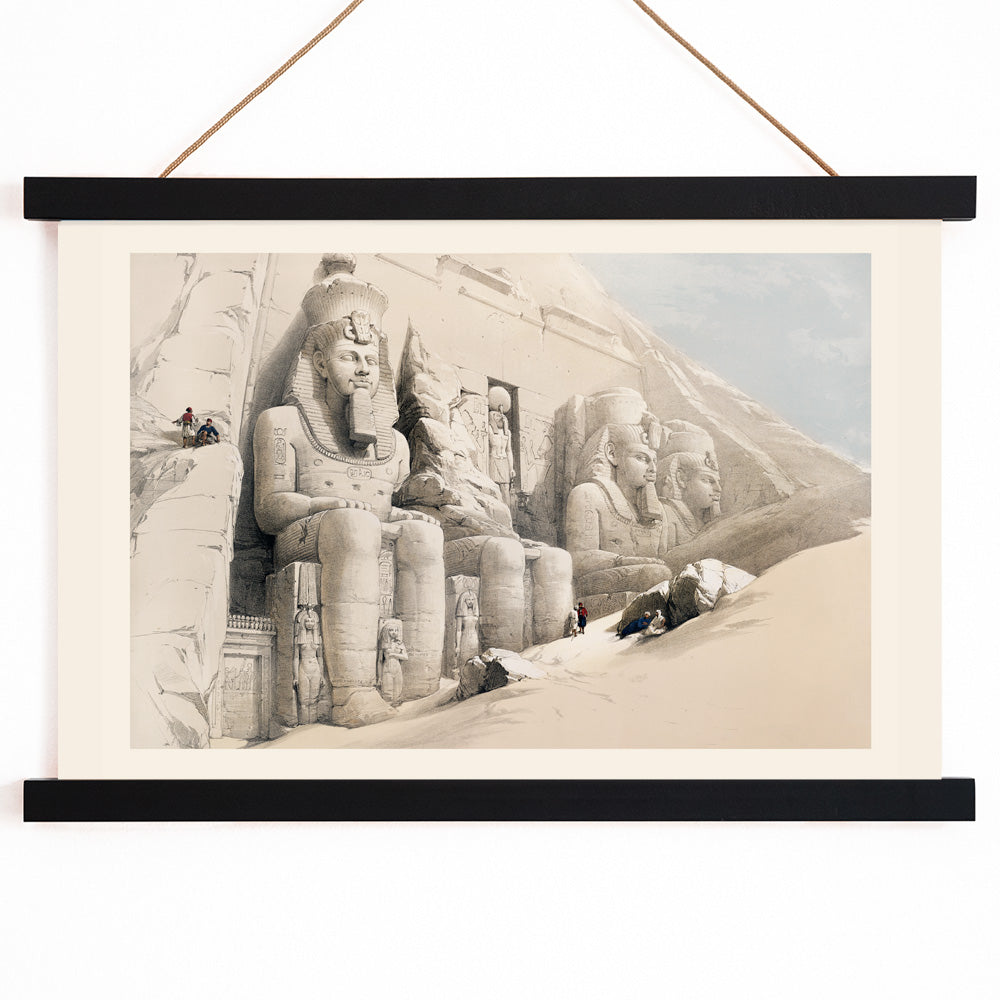
The Great Temple of Abu Simbel, as depicted by Roberts, captures the fascination and awe that ancient Egyptian monuments inspired in 19th-century Europe. Created during his 1838-1839 journey along the Nile, this work introduced Western audiences to the grandeur of Nubian antiquities, making sites like Abu Simbel icons of archaeological discovery and imperial imagination.
Roberts’s print was more than a travel memento; it became a cultural bridge, connecting the mysteries of ancient civilizations with the aspirations of his own time. The image reflects the spirit of exploration and the enduring allure of monumental architecture carved from living rock.
Style & Characteristics
The composition centers on the imposing facade of Abu Simbel, where four colossal seated statues of Ramses II are carved directly into the sandstone cliff. Tiny figures at the base emphasize the immense scale and invite viewers to appreciate the site’s grandeur.
The palette features warm sandy beiges, muted stone greys, and a clear blue sky, creating a tranquil, sunlit effect characteristic of topographical travel art. Fine linear details and subtle shading lend the print a crisp, engraved quality, making it a refined choice for collectors of landscape art and admirers of architectural subjects.
In Interior Design
This poster serves as a striking focal point in living rooms, studies, or hallways, offering architectural gravitas without overwhelming the space. Its neutral tones harmonize with limestone, oak, leather, and brushed metal, suiting both modern and classic interiors.
To create a cohesive look, pair the artwork’s beige and grey hues with warm neutrals, and introduce blue accents through ceramics or textiles. It also complements travel-inspired decor and curated gallery walls, especially when combined with other pieces from our beige collection.