




-

"Very nice Posters. The quality is amazing and we received it very quickly !"
-

"A shop to visit absolutely. Huge selection of posters. We spent more than an hour there !"
-

"Perfect to find gift. Price are very good. An they can frame and pack it on site"


About the Artist
Charles Melville Scammon was an American sea captain and naturalist whose firsthand experience with Pacific whales in the 19th century made him a pivotal figure in marine science. His dual role as both whaler and observer gave him unique access to the habits and forms of these elusive animals, and his detailed documentation contributed significantly to early cetacean studies.
Scammon’s publications, combining narrative accounts with scientific illustration, helped establish a foundation for the systematic study of whales in North America. His legacy endures in both natural history and maritime heritage, valued by collectors and scholars alike.
The Artwork
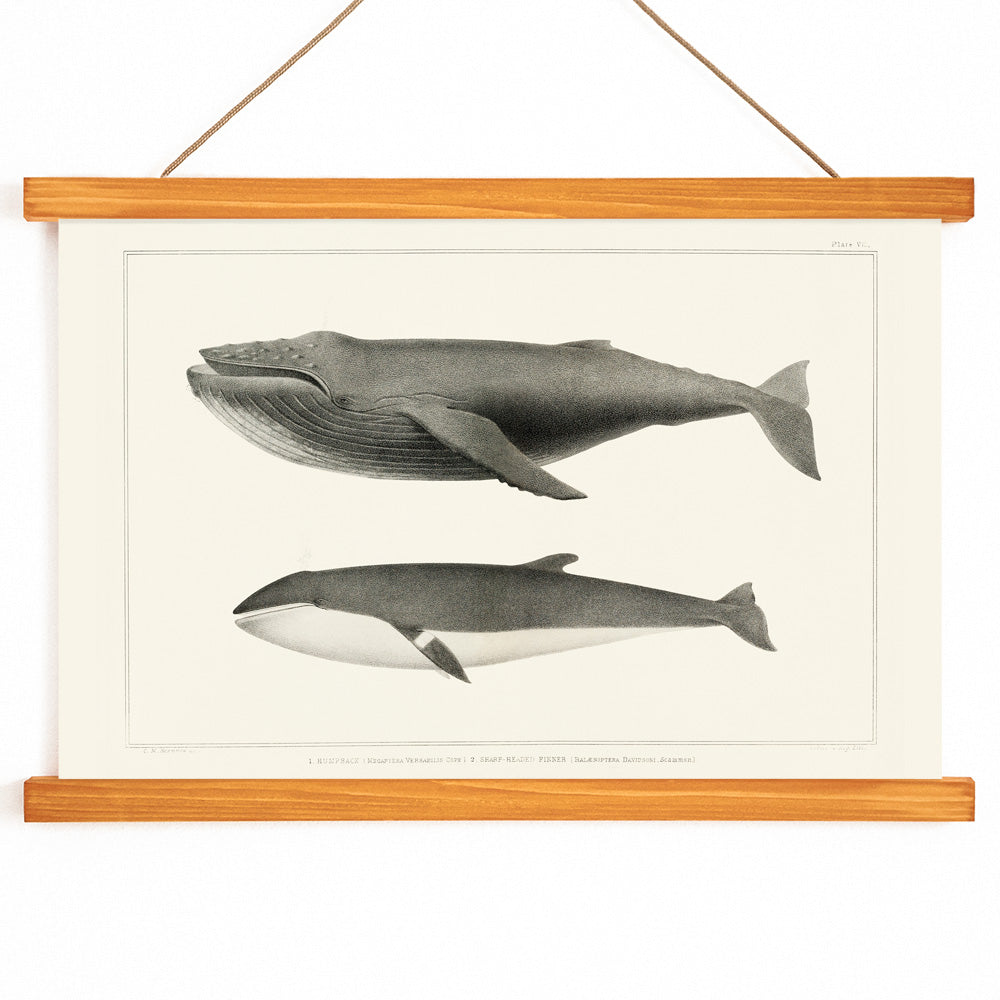
Produced in 1872, this plate was created during a period of intense cataloging of marine species, when explorers and scientists sought to document the diversity of the oceans. The illustration directly compares the humpback whale and the minke whale, serving as a visual aid for identification at a time when scientific reference materials were scarce and highly prized.
Such images were essential for education and research, bridging the gap between field observation and academic study. This work reflects the era’s drive to make the mysteries of the sea accessible to a wider audience through careful illustration and publication. For more from this period, explore our sea and ocean wall art and science prints.
Style & Characteristics
The artwork features a precise, side-profile depiction of both whale species, rendered with fine lines and subtle shading. The restrained composition focuses on anatomical accuracy, highlighting the differences in shape and proportion between the two whales.
The muted palette of greys and whites lends the print a quiet, archival quality, typical of 19th-century scientific plates. The overall mood is contemplative and informative, making it well-suited to interiors that value understated, educational art. For related imagery, see our animal illustrations.
In Interior Design
This vintage print complements spaces with a calm, structured aesthetic—such as coastal, Scandinavian, or minimalist interiors. Its vertical format makes it ideal for studies, entryways, or as part of a gallery wall, where it adds a thoughtful, scholarly note without overwhelming the room.
Pair with neutral frames and natural textures for a refined look, or combine with other natural history prints for a cohesive, curated display. It is especially appealing in home offices or libraries where a sense of discovery and learning is desired.