




-

"Very nice Posters. The quality is amazing and we received it very quickly !"
-

"A shop to visit absolutely. Huge selection of posters. We spent more than an hour there !"
-

"Perfect to find gift. Price are very good. An they can frame and pack it on site"


About the Artist
Edward Penfield was a pioneering American illustrator and a central figure in the development of poster art at the turn of the 20th century. As art director for Harper's Magazine, he played a crucial role in shaping the visual language of American advertising, favoring clarity and directness over ornate detail. Penfield’s work is recognized for its influence on both commercial art and the early evolution of graphic design.
His posters became icons of their era, reflecting the optimism and technological progress of the late 1800s. Today, Penfield is celebrated among famous artists for his lasting contributions to classic poster design and the visual culture of modern advertising.
The Artwork
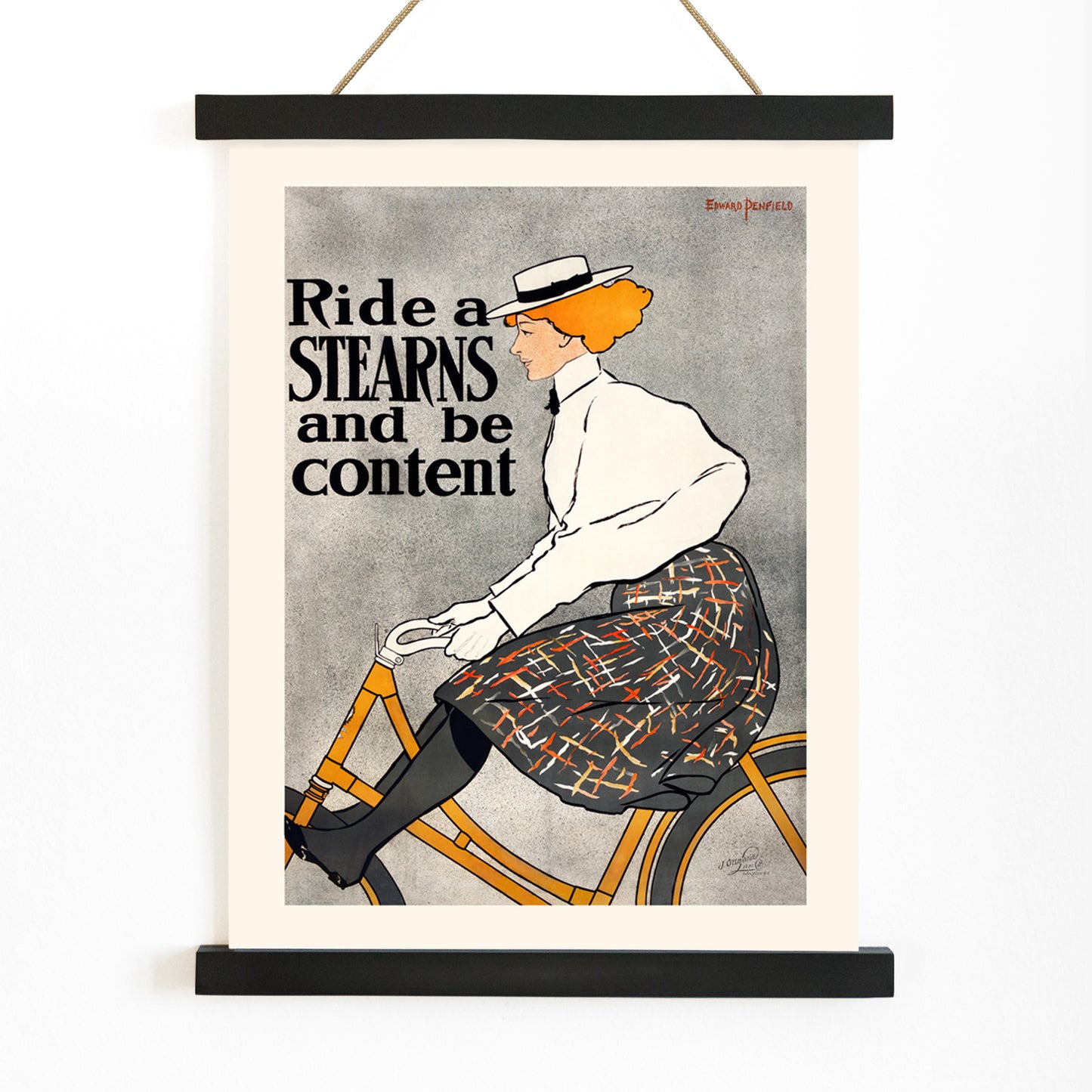
Created in 1896, Ride a Stearns and be content emerged during the height of the bicycle craze that swept through America and Europe. This period marked a dramatic shift in urban mobility and personal freedom, as bicycles became accessible symbols of progress and independence. Companies like Stearns commissioned striking posters to capture the imagination of a public eager for new forms of recreation and transport.
This artwork reflects the era’s spirit of innovation and aspiration, using advertising not just to sell a product, but to promote a lifestyle of modernity and self-reliance. It stands as a testament to the transformative power of the bicycle in late 19th-century society, and the role of posters in shaping popular culture.
Style & Characteristics
The poster features a solitary cyclist rendered in bold, simplified forms, set against a pale background that enhances the figure’s prominence. Penfield employs a restrained palette of grey, white, orange, and black, creating strong visual contrast and a sense of warmth. The large, clear lettering is integrated seamlessly into the composition, ensuring the message is instantly readable even from a distance.
Characteristic of Penfield’s style, the artwork avoids intricate detail in favor of broad shapes and confident outlines, lending the scene a timeless, graphic quality. The overall mood is poised and optimistic, embodying both the elegance and energy of vintage advertising art. For those interested in cycling history, it also connects naturally with our bike collection.
In Interior Design
This vintage poster brings a touch of classic Americana to entryways, studies, or creative workspaces, where its clean lines and dynamic composition can set a sophisticated tone. Its neutral and orange hues pair well with modern, Scandinavian, or mid-century interiors, especially when complemented by black or grey accents.
Consider framing it with a simple mat to highlight its graphic qualities. For a cohesive display, explore related works in our bike and frames collections to curate a gallery wall that celebrates both design heritage and contemporary style.